

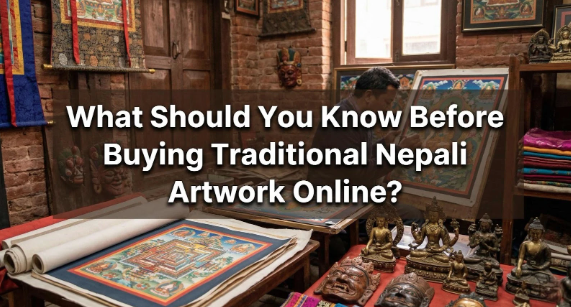
There’s a moment many buyers describe: the one where they unbox a piece of Nepali art they ordered online, hold it up to the light, and feel something shift inside them. The color, the detail, the silent spiritual weight of it.
But then there are the other stories: one paying a high premium price on what turned out to be a mass-printed copy, or worse, a sub-par, poorly made imitation with none of the craftsmanship they thought they were getting.
This is by no means to say that you need to lose money buying online, but in case you are attracted to Nepali art with its fascinating traditions, its multi-layered symbolism, centuries of artisanship behind it, you do not need to gamble.It just requires knowing what to look for.
Understand What You’re Actually Buying
Nepal has a remarkably diverse artistic tradition. It is better to be aware of what kind of art you want to browse before you begin, since the term traditional Nepali artwork is a broad term that includes a lot of stuff that is greatly different.
- Thangkas: Sacred Buddhist scroll paintings on cotton or silk, being used in meditation and religious practice.
- Mithila Paintings: Originating in the Terai region, these are known for bold lines and folk imagery.
- Sculptures: This includes wood panels, metals and stone sculptures.
- Nepalese Hand Paintings: These span everything from intricate deity portraits to decorative mandalas—each made with pigments, patience, and a steady hand that takes years to develop.
Being informed about the exact art type you desire will allow you to ask more valuable questions, spot the fake ones more easily and find sellers who actually specialize in what you’re after.
The Authenticity Question – And Why It’s Complicated
Here’s the honest truth: not all of the items mentioned as traditional or handmade online actually are. Other works are printed on paper or canvas using the computer and then made to appear old. Some of them are actually crafted by untrained workforces that create mass products to sell to the tourist market.
How would you know the difference?
- Look at the details closely: The natural variation of a true piece of hand-painted work will be lost, and one will notice slight deviation of lines, little mistakes in the brushwork, and places where the colour has been layered and built up. A printed piece will look perfectly uniform under magnification.
- Ask for provenance: The seller with a good reputation must be capable of informing you about where it was produced, by whom, and in which workshop, and ideally should provide some photos of the work in progress. There are a large number of serious Nepali art sellers who have long-term relationships with individual families or cooperatives.
- Be skeptical of suspiciously low prices: A true thangka drawn by a skilled painter in Bhaktapur or Patan, using gold detailing and natural mineral colors, does not finish in a few days. It can not be morally sold at $30.
Learn a Little About Paubha Before You Buy

Among the most sacred and often misunderstood forms of Nepali painting is Paubha—a traditional Newari genre of sacred painting that predates the thangka style and follows strict iconographic rules. If you come across Paubha Arts in Nepal, understanding even the basics will help you appreciate what you’re looking at and evaluate whether a piece is genuine.
The Paubha paintings are authentic and have strict iconographic rules, the position of figures, the color of robes, the gestures of hands, the symbolic objects in the hands of deities—all this is no accident. These rules are learned by years of training under a master. An authentic Paubha will not be arbitrary and would be composed appropriately, but not ornamental. A genuine Paubha will feel harmonious and precisely composed, not random or decorative. If a seller can’t explain the iconography of what they’re selling, that is a red flag.
Vet the Seller Carefully
Making purchases of art over the internet is a matter of faith in the seller as much as it is in the artwork itself. The following are some of the things that can be checked:
- Reviews and history: How many years have they been selling? What do past buyers say about accuracy of description, packaging, and communication? Look for the reviews that refer to specifications, such as size, material, condition on arrival, rather than vague praise.
- Return policy: Legitimate sellers are generally willing to accept returns if a piece is significantly misrepresented. Also watch out for the sellers that say everything is final, especially on high value items.
- Direct communication: Contact the seller via email or message a seller before purchasing. Ask specific questions regarding the piece—what is it made of, what is the background of the artist, the approximate age. An informed seller will answer in detail. A reseller of mass-produced goods usually can’t.
- Ethical sourcing and fair trade: Nepal has a number of excellent craftsmen, who are employed by cooperatives or NGOs, which guarantee fair wages and safe working conditions. Buying from these organizations means your money actually reaches the craftsperson.
Practical Matters: Shipping, Customs and Care
Some of the surprises that first-time customers tend to have:
- Shipping methods: Thangkas are rolled and stretched differently. Most works can be rolled into a tube that is safe; however, large or delicate works are to be sent unrolled and heavily padded. Ask the seller how they pack before you order.
- International customs: International customs vary. When it comes to artwork, you can pay an import duty depending on your place of residence. Before purchasing, make sure you have checked the regulations of your country, particularly in regards to more expensive items.
- Maintenance: Care matters once it arrives. Thangkas and hand-painted works do not appreciate direct sunshine and humidity. In case of framing, UV-protective glass is employed. In case you are rolling it up to store it, then roll it gently with the painted side facing out.
A Final Word
Buying traditional Nepali artwork online can be a genuinely wonderful experience, a way to bring something meaningful into your home while supporting artists and craftspeople whose traditions go back generations. The key is to approach it with a little knowledge, a little patience, and a healthy dose of curiosity.
Ask questions. Do some research. Don’t rush toward the cheapest option. And when you come across a seller who obviously knows what he/she is selling and loves what they are selling, then it is normally a good indicator that you are at the right place.
The art will thank you for it.
